
Samarkand is one of the most incredible places to visit in Uzbekistan. This ancient Silk Road city is famous for its magnificent blue-tiled madrasas, enormous mosques and spectacular architecture. With more than 2,500 years of history, it’s a fascinating destination and one of the highlights of travelling through Central Asia.
When I visited Samarkand, I was blown away by the incredible buildings. Places like Registan Square and Shah-i-Zinda are even more impressive in person, and I loved exploring the city and discovering the extraordinary details in its architecture.
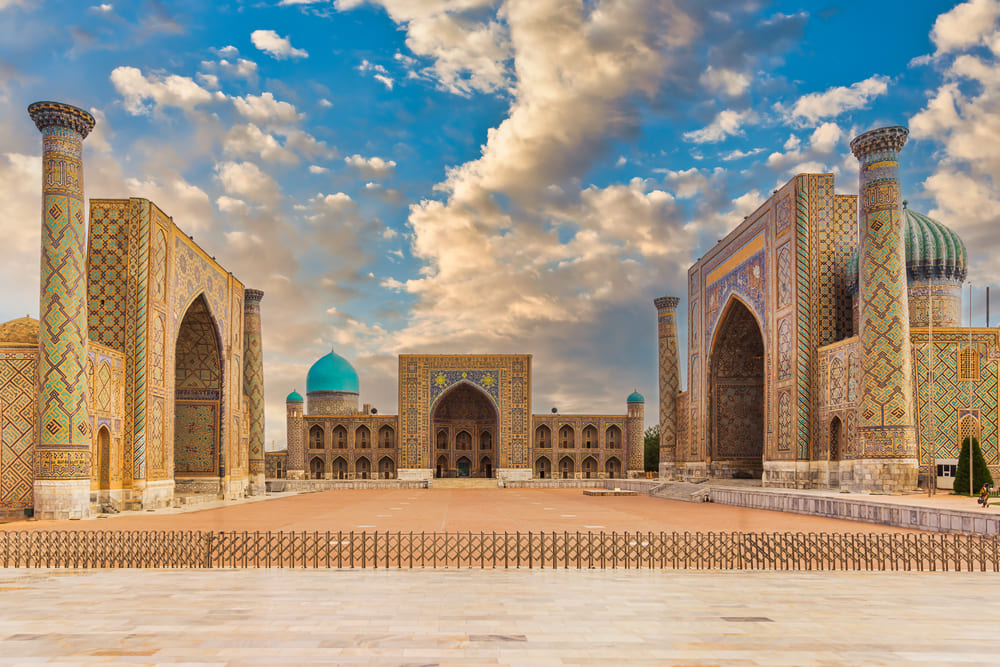
But there’s more to Samarkand than its famous monuments. I also enjoyed wandering through the streets, visiting the bustling Siab Bazaar and experiencing everyday life in this historic city.
In this guide, I’ll share my ten favourite things to do in Samarkand, from its magnificent mosques and mausoleums to its fascinating museums and traditional markets. I’ll also explain some of the city’s history and how to get here from other popular destinations in Uzbekistan, so you can plan your own incredible trip.
A Brief History of Samarkand
Samarkand is one of the oldest cities in Central Asia, with a history stretching back more than 2,500 years. Long before the Silk Road became an important trading network, the city was already a significant settlement in the ancient region of Sogdiana.
Its location eventually made Samarkand one of the great trading centres of the Silk Road, connecting merchants travelling between China, Persia, India and the Mediterranean. Over the centuries, the city became an important meeting point for different cultures, religions and ideas.
Samarkand was ruled by several powerful empires, including the Persian Achaemenids, before Alexander the Great captured it in 329 BCE. Following the Arab conquest in the early eighth century, Islam gradually became an important part of the city’s identity.
The city flourished as a centre of trade and learning but suffered enormous destruction when Genghis Khan’s Mongol armies invaded in 1220.
Samarkand’s most famous period began in the late 14th century, when Timur (Tamerlane) made it the capital of his vast empire. He brought skilled craftspeople from across his conquered territories to create magnificent buildings, including the enormous Bibi-Khanym Mosque and Gur-e Amir Mausoleum.
His grandson Ulugh Beg continued this cultural and intellectual development in the 15th century. A talented astronomer and mathematician, he established an important observatory and commissioned the Ulugh Beg Madrasa at Registan Square.
Over the following centuries, Samarkand’s political importance declined as Bukhara became a more prominent centre of power. The city later came under Russian control in 1868 and became part of Soviet Uzbekistan before the country gained independence in 1991.
Today, Samarkand is a UNESCO World Heritage Site, celebrated for its extraordinary Islamic architecture and its importance in Silk Road history. It’s one of the most incredible places to visit in Uzbekistan, particularly if you love history and magnificent historic buildings.
10 Super Cool Things To Do In Samarkand For An Incredible Trip! 🤩
1. Visit Registan Square
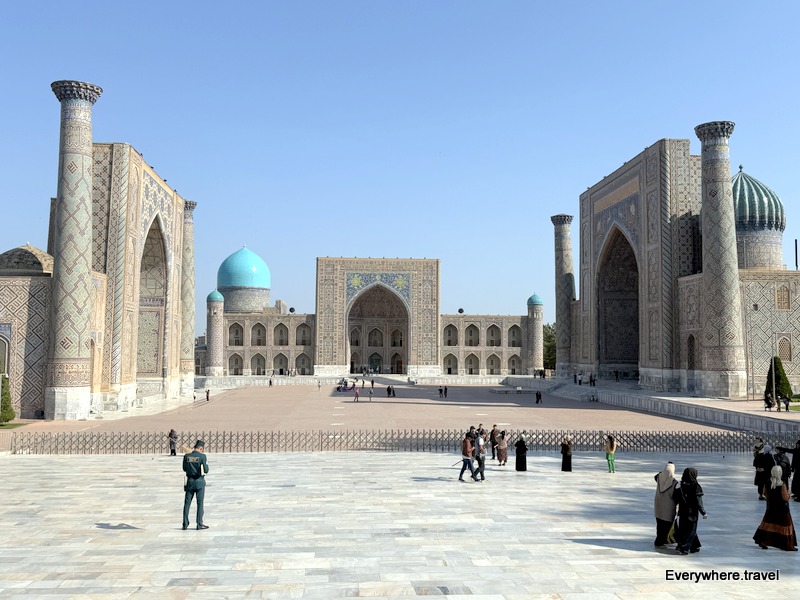
Registan Square is the most famous attraction in Samarkand and one of the most spectacular places I’ve visited in Uzbekistan. The enormous square is surrounded by three magnificent madrasas, covered in intricate blue tiles, mosaics and beautiful Islamic geometric patterns.
The three buildings are the Ulugh Beg Madrasa, built in the early 15th century, and the Sher-Dor and Tilya-Kori madrasas, which were added in the 17th century. Together, they create one of the most impressive architectural ensembles in Central Asia.
I recommend taking time to admire each building individually rather than just photographing the square from the entrance. The details are incredible, particularly the colourful animal mosaics on the Sher-Dor Madrasa and the lavishly decorated interior of the Tilya-Kori Madrasa.
You can also explore parts of the buildings, including their courtyards and former student rooms, many of which now contain souvenir shops and traditional handicrafts.
Registan is particularly beautiful in the late afternoon when the sunlight brings out the colours of the tiles. It’s also worth returning after dark to see the buildings illuminated.
If there’s one attraction you absolutely shouldn’t miss in Samarkand, this is it.
2. Explore Shah-i-Zinda
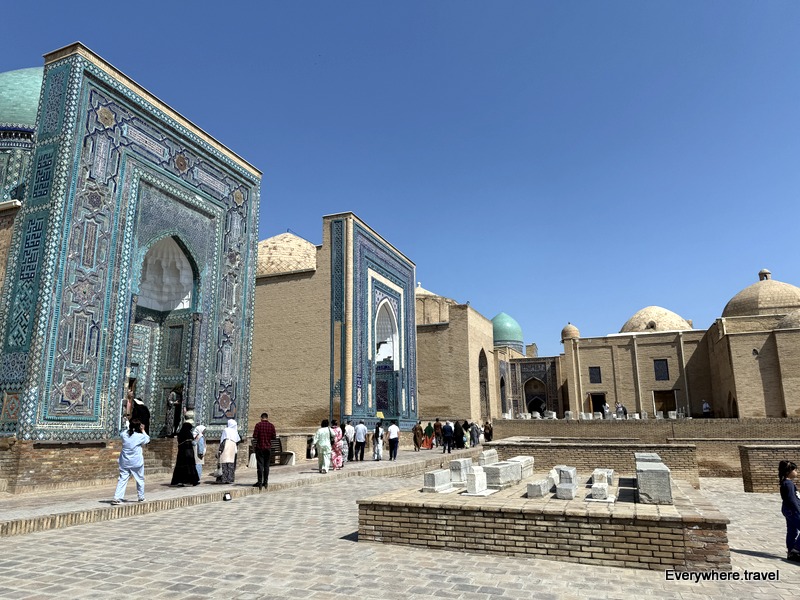
Shah-i-Zinda is another of Samarkand’s most spectacular attractions. This extraordinary complex consists of a narrow avenue lined with beautifully decorated mausoleums, many covered in intricate blue and turquoise tiles.
The name Shah-i-Zinda means “The Living King” and refers to a legend that Qutham ibn Abbas, a cousin of the Prophet Muhammad, survived his apparent death and continues to live spiritually at the site.
The site has been an important pilgrimage destination for centuries, and its religious significance continues today.
Many of the mausoleums date from the 14th and 15th centuries, although the complex contains buildings from several different periods. They were constructed for members of the Timurid elite and other important figures.
What makes Shah-i-Zinda particularly special is the incredible variety of tilework. Each mausoleum has its own patterns, colours and decorative details, making it a fantastic place to explore slowly.
You’ll reach the main avenue by climbing a staircase, and I recommend allowing plenty of time to appreciate the buildings rather than rushing through.
Remember that Shah-i-Zinda is also a sacred site, so dress respectfully and be considerate of people visiting to pray.
For me, this is one of the most beautiful places in Samarkand and an absolute must-visit.
3. Discover the Bibi-Khanym Mosque
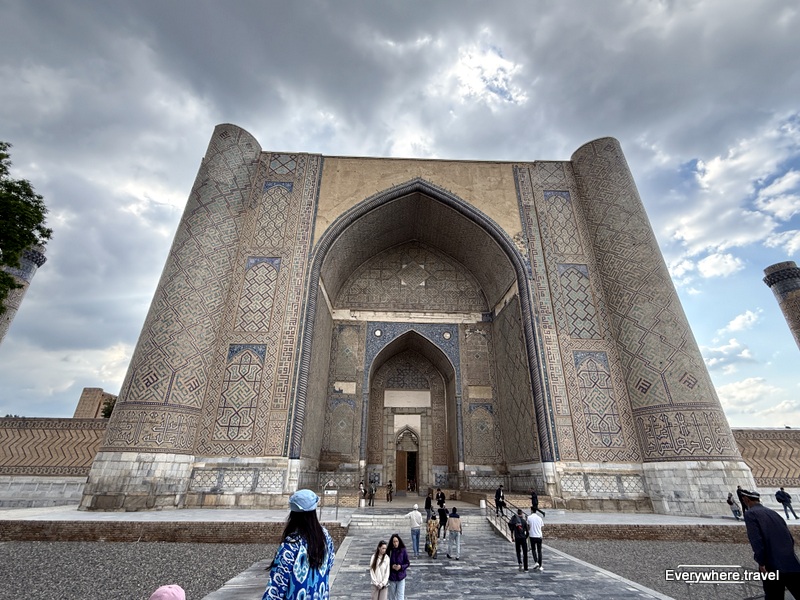
The Bibi-Khanym Mosque is one of the most impressive reminders of Samarkand’s importance under Timur. Built between 1399 and 1404, it was intended to be one of the largest and most magnificent mosques in the Islamic world.
The enormous entrance portal gives you an immediate sense of the scale of Timur’s ambitions. Even compared with Samarkand’s other spectacular buildings, this mosque is incredibly impressive.
The mosque is named after Bibi-Khanym, Timur’s principal wife, and several legends connect her to its construction. However, historians generally attribute the project to Timur himself.
Unfortunately, the building suffered from structural problems and deteriorated over the centuries. Much of what you see today has undergone substantial restoration, although sections of the original architecture survive.
Inside the complex, you can explore the large courtyard and admire the towering portals, blue domes and elaborate tilework. There’s also an enormous stone Quran stand in the courtyard, another distinctive feature of the site.
I recommend visiting Bibi-Khanym alongside the nearby Siab Bazaar. They’re very close together, making it easy to combine two quite different experiences in Samarkand.
4. Stroll Through the Siab Bazaar
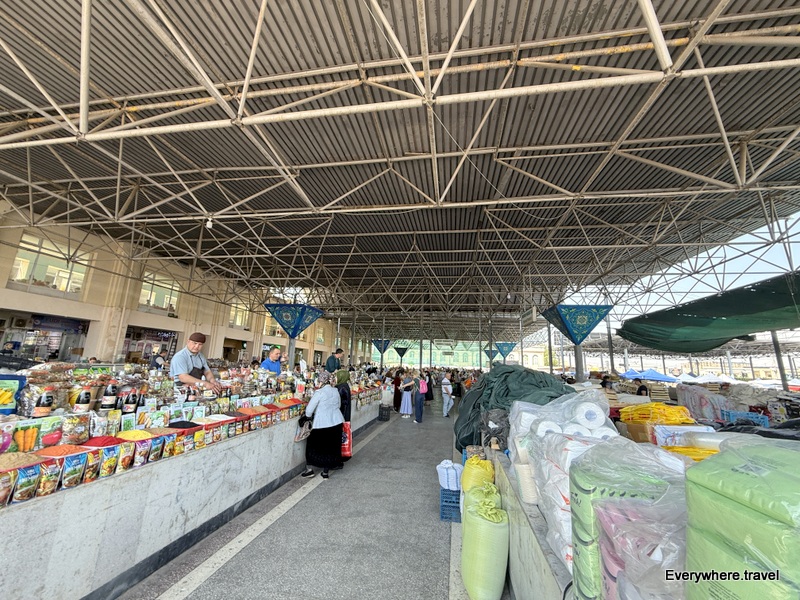
After exploring Samarkand’s magnificent historic monuments, Siab Bazaar is a fantastic place to experience everyday life in the city.
Located close to the Bibi-Khanym Mosque, this bustling market is packed with stalls selling fresh fruit, vegetables, nuts, dried fruit, spices, sweets and traditional Uzbek food.
One thing I particularly recommend looking out for is Samarkand’s famous round bread, known as non. This traditional bread has a thick outer crust and a beautifully decorated centre, and it’s one of the foods the city is particularly famous for.
You’ll also find plenty of dried apricots, raisins, nuts and other local produce. It’s a great place to pick up snacks or edible souvenirs while experiencing a different side of Samarkand.
Although the market attracts tourists, it’s also used by local residents, making it an interesting contrast to the city’s grand historic attractions.
I recommend wandering through the different sections, taking in the atmosphere and stopping to try some local specialities.
Siab Bazaar is an easy addition to your sightseeing itinerary, particularly if you’re already visiting the Bibi-Khanym Mosque.
5. Admire the Ulugh Beg Observatory
The Ulugh Beg Observatory is one of Samarkand’s most fascinating historic sites, particularly if you’re interested in science and astronomy.
Built in the 1420s under the direction of Ulugh Beg, the Timurid ruler and astronomer, it was one of the most advanced astronomical observatories of its time.
Ulugh Beg gathered leading mathematicians and astronomers in Samarkand, where they carried out remarkably accurate observations of the stars and planets centuries before modern telescopes were invented.
Although the original observatory was largely destroyed, one extraordinary feature survives: part of an enormous astronomical instrument built into the ground.
This giant meridian arc, commonly described as part of a sextant or quadrant, was used to measure the positions of celestial objects with remarkable precision.
You can see the surviving section in a covered trench, which gives you an idea of the enormous scale of the original instrument.
There’s also a museum nearby explaining Ulugh Beg’s work, including the astronomical tables and star catalogue produced by scholars working at the observatory.
The observatory is located a little outside Samarkand’s main historic centre, so you’ll probably want to take a taxi rather than walk from Registan Square.
I recommend visiting if you have time, particularly because it offers something quite different from the mosques and madrasas that dominate most Samarkand itineraries.
6. Visit the Afrasiab Museum
The Afrasiab Museum is one of the most interesting places to visit in Samarkand if you want to understand what the city was like long before Timur transformed it into his magnificent capital.
The museum stands beside the archaeological remains of ancient Afrasiab, the site of Samarkand’s original settlement. This was once a thriving city, but much of it was destroyed during the Mongol invasion in 1220.
What I find particularly fascinating about this museum is how it reveals a completely different side of Samarkand’s history. After spending so much time admiring the city’s enormous blue-tiled monuments, it’s interesting to discover the civilisations that existed here centuries earlier.
The museum’s highlight is its extraordinary collection of seventh-century wall paintings, discovered in the ruins of an ancient Sogdian palace. These colourful paintings depict diplomatic processions, foreign visitors and ceremonial scenes, revealing Samarkand’s connections with places as far away as China and Korea.
There are also archaeological displays featuring pottery, coins and other objects discovered at Afrasiab, helping you understand what everyday life was like in the ancient city.
I recommend combining the museum with the nearby Ulugh Beg Observatory, as they’re both outside the main historic centre and provide fascinating insights into Samarkand beyond its famous mosques and madrasas.
7. Walk Through the Old City
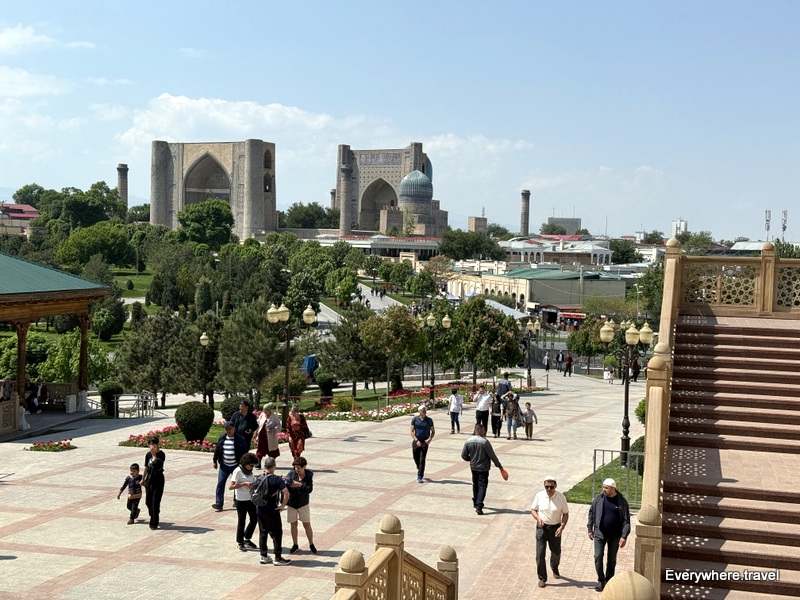
One of my favourite things to do when visiting historic cities is simply wander around without a particular destination in mind, and Samarkand is a great place to do this.
While the city’s famous monuments are spectacular, I also recommend spending some time exploring the smaller streets and traditional neighbourhoods around the historic centre.
Away from the main tourist attractions, you’ll find quieter residential lanes, traditional courtyard houses, small local shops and glimpses of everyday life in Samarkand.
It’s a very different experience from standing in front of the enormous madrasas at Registan Square, and I love seeing both sides of a destination.
Not all of Samarkand’s old neighbourhoods have survived unchanged, and parts of the historic centre have been extensively redeveloped. However, exploring the streets around the major monuments is still a great way to appreciate the city’s atmosphere.
I recommend allowing time to wander between attractions rather than taking a taxi everywhere. You’ll discover little details and interesting streets that you might otherwise miss.
For me, this is one of the best ways to experience Samarkand beyond its famous landmarks.
8. Tour the Tamerlane Mausoleum (Gur-e Amir)
Gur-e Amir is one of Samarkand’s most impressive buildings and another attraction I consider an absolute must-see.
This magnificent mausoleum is the final resting place of Timur (Tamerlane), the powerful conqueror who made Samarkand the capital of his empire in the late 14th century.
The building was originally constructed for Timur’s grandson Muhammad Sultan, who died in 1403. Timur himself was buried here after his death in 1405, along with several other members of the Timurid dynasty.
From outside, the mausoleum is spectacular, with its enormous ribbed turquoise dome and beautifully decorated entrance. However, I think the interior is even more impressive.
The walls and ceiling are covered in elaborate blue and gold decorations, creating one of the most extraordinary interiors in Samarkand. There’s so much detail that it’s worth taking your time to look around rather than simply walking through.
Inside, you’ll see several beautifully carved stone tomb markers, including a dark green nephrite jade cenotaph associated with Timur. The actual burials are in a crypt beneath the main chamber.
I particularly recommend Gur-e Amir if you love architecture. After visiting so many beautiful buildings in Samarkand, it’s incredible how this one still manages to stand out.
It’s also worth seeing the exterior after dark, when the lighting highlights the magnificent dome and entrance.
9. Visit Hazrat Khizr Mosque
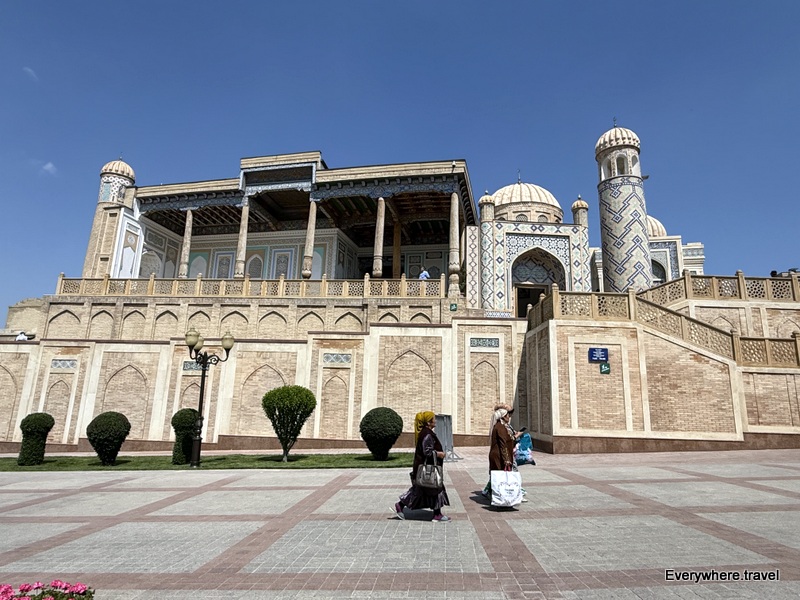
Hazrat Khizr Mosque is another beautiful historic building in Samarkand, and it’s particularly worth visiting for its location and views over the city.
The mosque stands on a hill overlooking the area around Bibi-Khanym Mosque and Shah-i-Zinda. Although the site has a much longer religious history, the present mosque largely dates from the 19th century.
It’s dedicated to Khizr, a revered figure in Islamic tradition who is associated with wisdom, guidance and spiritual knowledge.
The building is quite different from Samarkand’s enormous Timurid monuments. Its elegant wooden columns, colourful painted ceilings and decorative details give it a distinctive character.
One of the things I love about visiting historic cities is finding places where you can look back across the buildings you’ve been exploring, and Hazrat Khizr is a great spot for this.
From the elevated position, you can enjoy views over parts of Samarkand and appreciate the scale of the surrounding historic monuments.
The site also contains the mausoleum of Islam Karimov, Uzbekistan’s first president, who died in 2016 and was buried here.
I recommend stopping at Hazrat Khizr when visiting Shah-i-Zinda or Bibi-Khanym Mosque, as all three attractions are relatively close together.
10. Explore the Tomb of Daniel
The Tomb of Daniel is one of Samarkand’s most unusual attractions and a fascinating place to visit if you’re interested in the city’s religious history.
Also known as the Mausoleum of Khoja Daniyar, this shrine is traditionally believed to contain relics associated with the prophet Daniel, who is revered in Judaism, Christianity and Islam.
What makes the site particularly unusual is the enormous tomb inside the mausoleum. At around 18 metres long, it’s unlike any other tomb I’ve come across.
There are several legends explaining its extraordinary length. One suggests that Daniel’s remains have continued to grow over the centuries, while another says the tomb was deliberately made long to conceal the exact location of the relics.
According to local tradition, Timur brought Daniel’s relics to Samarkand from the Middle East, although the historical accuracy of this story is uncertain.
The shrine is located near the Afrasiab archaeological site, away from the busiest parts of Samarkand’s historic centre.
It’s a relatively simple complex compared with the city’s magnificent blue-tiled monuments, but I think that’s part of what makes it interesting. After seeing so many enormous mosques and madrasas, visiting a place known for its unusual legends and religious significance offers something completely different.
I recommend combining the Tomb of Daniel with the Afrasiab Museum and Ulugh Beg Observatory, as they’re all located in the same general area.
How To Get To Samarkand
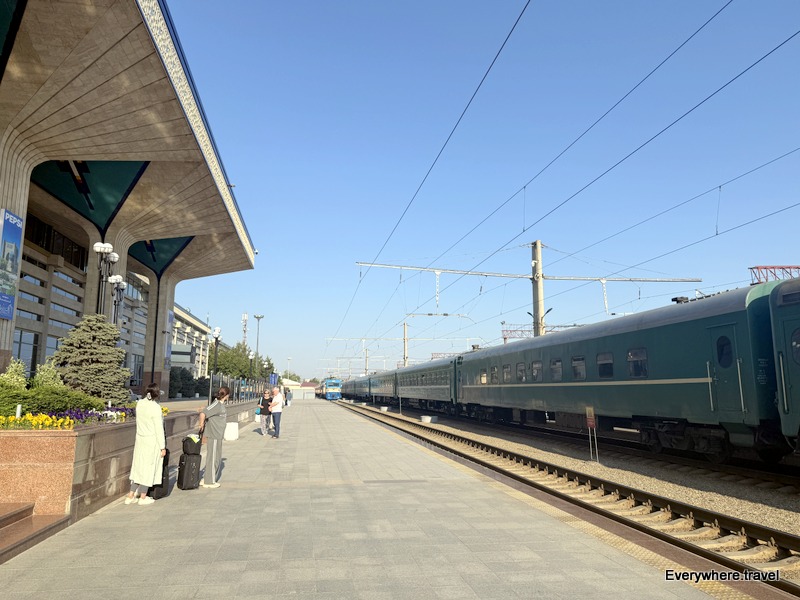
Samarkand is one of the easiest cities to visit in Uzbekistan thanks to the country’s excellent railway connections. It’s a popular stop on itineraries between Tashkent, Bukhara and Khiva, and I recommend travelling by train whenever possible.
Uzbekistan’s Afrosiyob high-speed trains are particularly convenient, offering comfortable journeys between the country’s major tourist destinations. You can book tickets through the official Uzbekistan Railways website.
Samarkand’s main railway station is located several kilometres northwest of the historic centre, so you’ll need a taxi or transfer to reach your accommodation.
Here’s how to get to Samarkand from some of Uzbekistan’s other popular destinations.
Getting to Samarkand from Tashkent
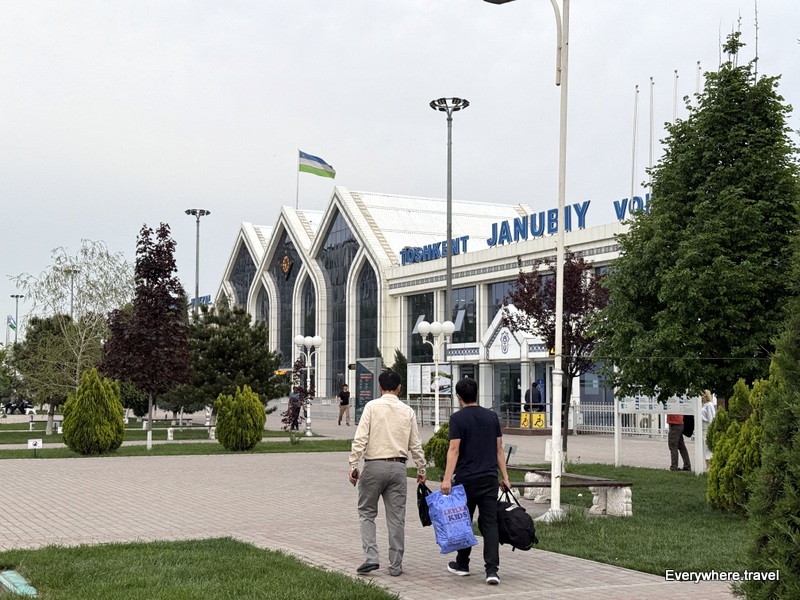
The easiest way to travel from Tashkent to Samarkand is by high-speed train. The Afrosiyob service takes approximately 2 hours and 10 minutes, making this a quick and comfortable journey.
There are generally several departures each day, although the timetable varies. I recommend booking ahead, particularly during the popular spring and autumn travel seasons, as high-speed trains can sell out.
Slower trains are also available and may be cheaper, although journey times are longer.
You can also travel by car or private transfer. The road distance is approximately 300 kilometres, and the journey usually takes around 4–5 hours, depending on traffic and road conditions.
For most travellers, I recommend the high-speed train. It’s quicker than driving and makes it easy to include Samarkand in a longer Uzbekistan itinerary.
Read my full guide to Tashkent here.
Getting to Samarkand from Bukhara

Travelling between Bukhara and Samarkand is particularly straightforward, and these two magnificent Silk Road cities are well worth combining on the same trip.
The fastest option is the Afrosiyob high-speed train, which takes approximately 1.5–2 hours. Conventional trains are also available, generally taking around 2.5–3 hours.
One thing to remember is that Bukhara’s main railway station is in Kagan, around 12–15 kilometres from Bukhara’s historic centre. You’ll need to allow time to reach the station before your departure.
Alternatively, you can hire a taxi or arrange a private transfer. The road journey is approximately 270 kilometres and generally takes around 3.5–4 hours.
I recommend travelling by train unless you specifically want the convenience of a door-to-door transfer.
Read my full guide to Bukhara here.
Getting To Samarkand From Khiva
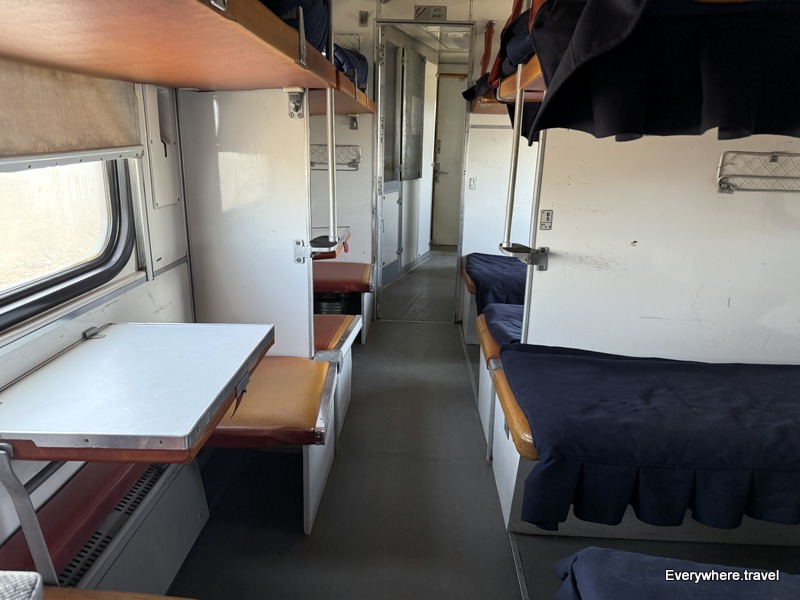
Travelling from Khiva to Samarkand takes considerably longer, but it’s still a manageable journey.
The most convenient option is generally to travel by train. Depending on the current timetable, you may be able to find a direct service from Khiva to Samarkand, although these are typically slower conventional trains.
Another option is to travel from Khiva to Bukhara and then continue to Samarkand. This can be particularly convenient if you’re planning to visit Bukhara anyway, as it’s one of Uzbekistan’s most interesting historic cities.
You can also arrange a private transfer. The road journey is approximately 700–750 kilometres and generally takes around 10–12 hours, depending on road conditions and stops.
For most travellers, I recommend breaking up the journey with a stay in Bukhara rather than travelling directly between Khiva and Samarkand.
If you’re travelling by train, check the latest Uzbekistan Railways timetable before finalising your itinerary, as routes and departure days can change.
Getting To Samarkand From Shakhrisabz
Shakhrisabz is the birthplace of Timur and an interesting destination to combine with Samarkand.
The two cities are approximately 90 kilometres apart via the mountain route, and the drive generally takes around 1.5–2 hours.
The most convenient option is to hire a taxi or arrange a private transfer. This gives you the flexibility to explore Shakhrisabz’s historic attractions and return to Samarkand on the same day.
The journey through the mountains can be particularly scenic, although the road may be affected by snow or poor weather during winter. Longer alternative routes may be necessary when the mountain pass is closed.
Shared taxis and other local transport options may also be available, although these are less convenient if you’re short on time.
I recommend visiting Shakhrisabz as a day trip from Samarkand if you have an extra day and want to explore more of Uzbekistan’s Timurid history.
Final Words
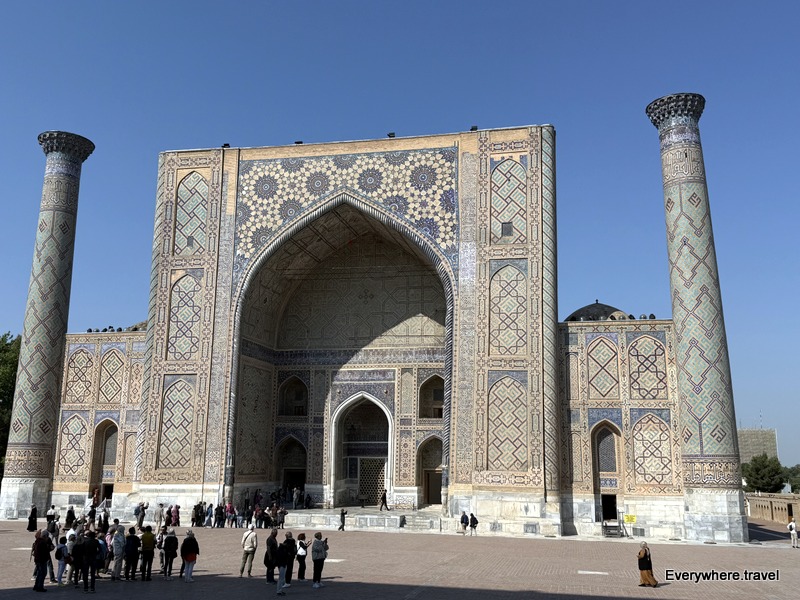
Samarkand is one of the most incredible places I’ve visited in Uzbekistan. The architecture is absolutely spectacular, and it’s hard not to be impressed by the enormous madrasas, beautiful blue domes and intricate tilework that seem to be everywhere.
Registan Square is undoubtedly the city’s most famous attraction, but I also loved discovering places like Shah-i-Zinda and Gur-e Amir. Each has something different to offer, and together they give you a fascinating insight into Samarkand’s history.
I recommend allowing at least two full days to explore Samarkand. This gives you enough time to visit the main attractions without rushing, wander through the historic streets and spend some time experiencing the city beyond its famous monuments.
If you have longer, there’s certainly enough to keep you busy, particularly if you want to visit Shakhrisabz or explore some of the attractions further from the centre.
Whether you’re travelling around Uzbekistan or visiting Samarkand as your main destination, it’s a city I definitely recommend including in your itinerary.
Planning to explore more of Uzbekistan? Read our guides to things to do in Bukhara and Tashkent, or browse our other Uzbekistan travel guides and Asia travel guides.