
If there was one thing my youngest son wanted to do in Tokyo, it was visit a capybara cafe. He absolutely loves capybaras, so there was no way we were going to Tokyo without getting up close to some.
What I didn’t realize before researching our trip was just how many capybara cafes there are in Tokyo – or how different they are.
Some have a single capybara. Others have several. Some mix capybaras with cats or other small animals. Session lengths range from just 30 minutes to an hour, prices vary considerably and the rules around advance bookings are surprisingly different.
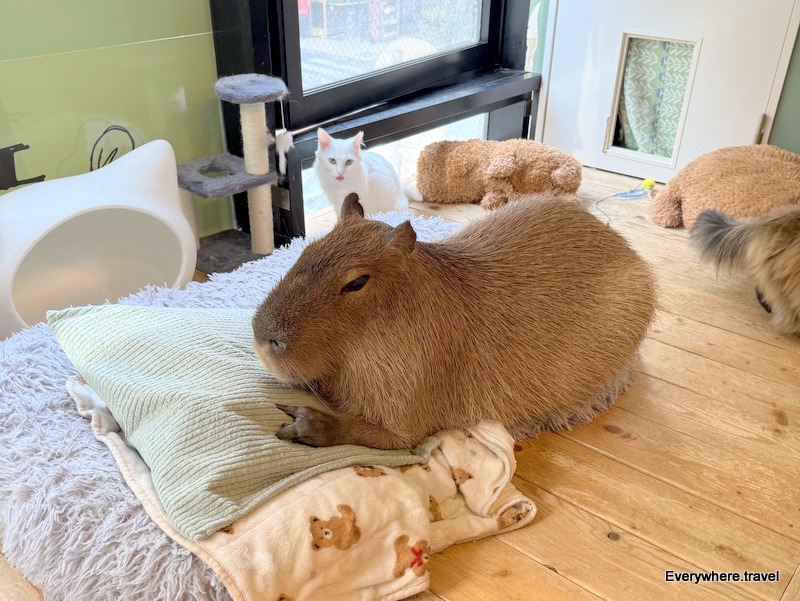
Over two trips, we’ve now visited Cafe Capyba Hikifune, Capyneko Kichijoji, CapyVillage and CAPPINESS Oshiage. Of the ones we’ve experienced so far, Cafe Capyba Hikifune is my pick for the best capybara cafe in Tokyo.
It’s one of Tokyo’s best-known capybara cafes, you get to spend time with two capybaras and, despite its popularity, it’s one of the better-value options. Most importantly, we had a great time.
However, it’s not necessarily the best choice for everyone. Capyneko adds cats to the experience, CapyVillage has several different animals, CAPPINESS offers a longer and more structured visit, while Moffu is right in the middle of Harajuku.
And really, my son doesn’t care at all which one he is at as long as he is playing with a capybara.
Comparison Of Capybara Cafes Tokyo
Below, I’ve compared the Tokyo capybara cafes so you can work out which is best for you. There is a full review of each below.
| Cafe | Location | Capybaras | Cost | Duration | Booking |
| Cafe Capyba | Hikifune | 2 | ¥2,300 | 30 mins | Book |
| Cafe Capyba | Asakusa | 2 | ¥2,300 | 30 mins | Book |
| Capyneko Cafe | Kichijoji | 1 | ¥2,800 | 40 mins | Book |
| Capyneko Cafe | Harajuku | 2 | ¥3,850 | 40 mins | Book |
| CAPPINESS | Shinjuku | 3 | ¥4,000 | 40 mins | Book |
| CAPPINESS | Oshiage | 3 | ¥4,000 | 40 mins | Book |
| CapyVillage | Sendagaya/Shibuya | 1 | ¥3,200* | 60 mins* | Book |
| Capybara Cafe Moffu | Harajuku | 3 | ¥4,000 | 30 mins | Book |
*CapyVillage has cheaper 30- and 45-minute options, but if you want to reserve in advance and guarantee your visit rather than taking your chances with same-day availability, I recommend comparing it using the ¥3,200 one-hour advance reservation as you cannot book the shorter times in advance.
Prices and conditions can change, so check the latest details when booking. This was correct at time of publishing. The different cafes also have different inclusions which are covered below.
What to Expect at Tokyo’s Capybara Cafes
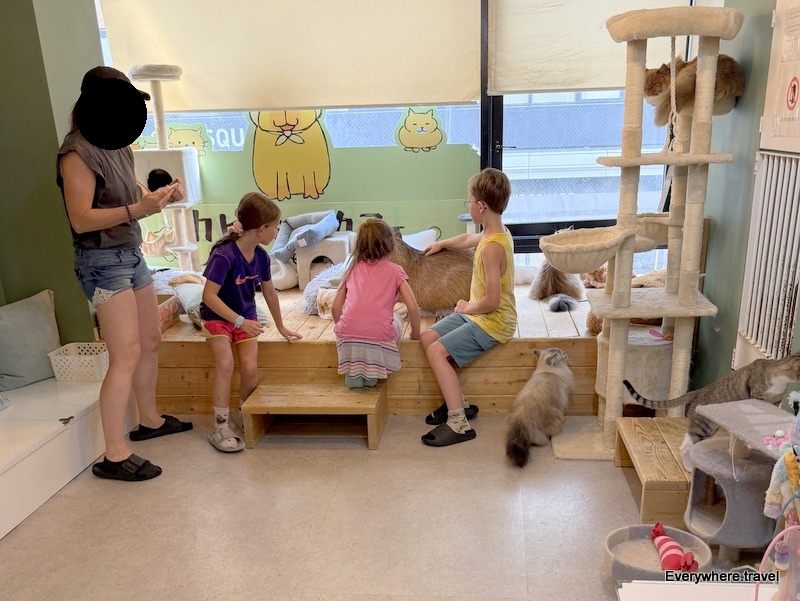
First, don’t imagine a normal cafe that happens to have a capybara sitting in the corner.
You’re primarily paying for a timed animal experience. The “cafe” part is secondary and there aren’t like cafes anywhere else in the world.
Depending on which one you choose, you’ll generally spend around 30–60 minutes in a relatively small space with the capybaras. You can watch them wandering around, sit beside them, pet them, take photos and, at most cafes, buy or receive food to feed them.
And yes, they really are as adorable in person as they look online.
They’re much bigger than you might expect, but incredibly chilled. They feel like a rough, old fashioned straw broom when you pat them.
One of the things I loved was simply being able to sit right beside them rather than looking at them through glass or across an enclosure.
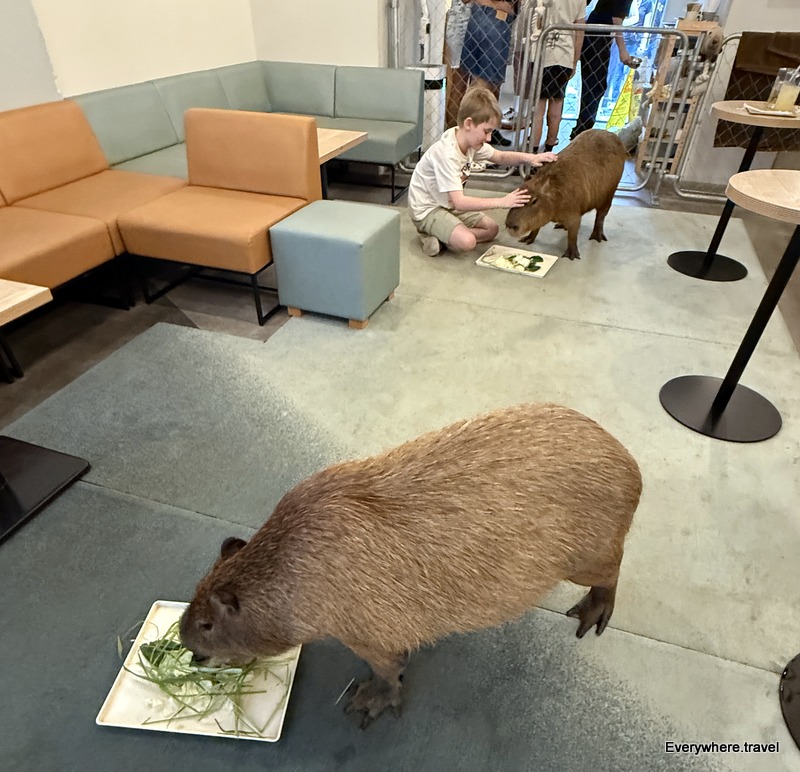
Food is also your secret weapon.
A capybara that’s perfectly content ignoring you can suddenly find you fascinating when you’re holding its favorite vegetables. If feeding isn’t included with your ticket, I think it’s worth paying extra for some food, particularly if this is likely to be your only capybara cafe Tokyo experience.
Don’t expect enormous venues. These are mostly small businesses with limited numbers of people allowed into each session, usually around 10. That’s part of what makes the interaction possible, but it also means the popular cafes can book out.
I had worried that having 8 other people there would be annoying, but I found other people to be considerate and we felt we had plenty of 1:1 time with the capybaras even in a 30-minute session.
I especially recommend you that you stay until the end of your session. Many people do leave early and our best moments were towards the end when it was just us and the capybaras.
You are asked to not wear strong scents such as perfume and you may have to take your shoes off and wear socks only.
I would reserve as soon as bookings open if there’s a particular cafe you really want to visit. Most cafes open up reservations 30 days in advance. For Capyba, the hardest one to book in my experience, it’s 14 days.
It’s also worth checking age restrictions carefully if you’re visiting Tokyo with kids. They vary considerably between cafes.
Finally, remember that you’re dealing with live animals rather than a theme park attraction. Capybaras can take breaks and cafes can change arrangements or even close temporarily because of an animal’s health. You’re paying for the opportunity to spend time around them, not a guaranteed performance.
Best Capybara Cafe In Tokyo Options
Most of your capybara cafe options are parts of chains that have two branches in different parts of Tokyo.
When working out which cafe to visit, I recommend you look at a map and pick options convenient for other places you wish to visit. Tokyo is spread out and we spent up to an hour traveling to some of the capybara cafes we visited.
Cafe Capyba – Hikifune and Asakusa
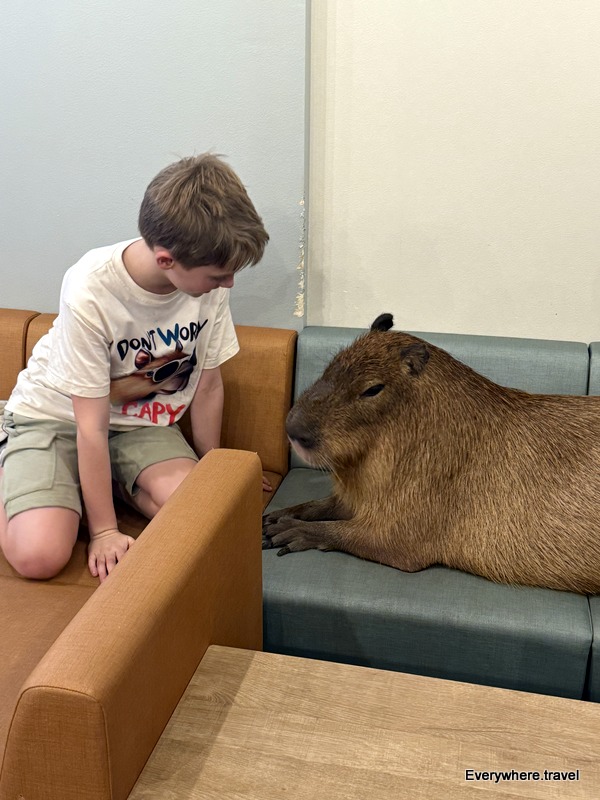
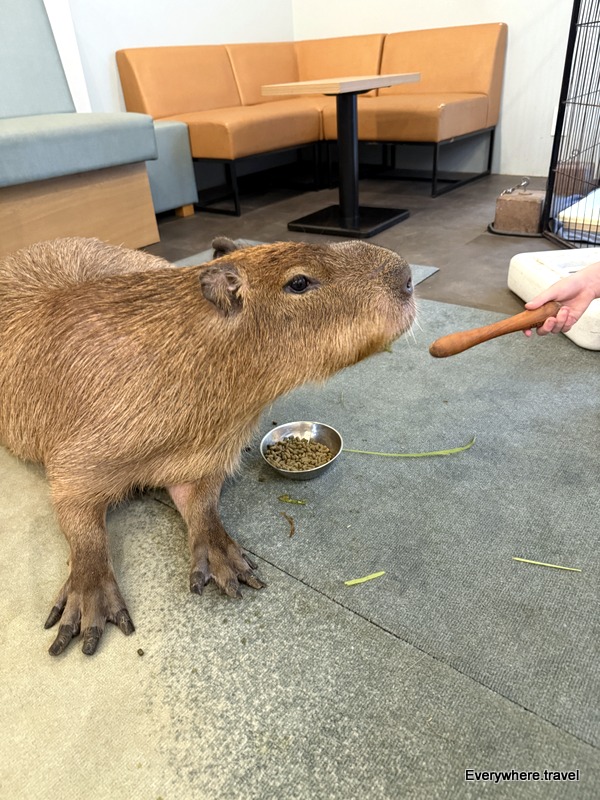
If you simply want a great capybara experience without lots of extras for a cheap price, Cafe Capyba would be my first choice.
This is the famous Tokyo capybara cafe I kept coming across when I first started researching where to take my capybara-obsessed son. The original is in Hikifune, near Tokyo Skytree, and a second Cafe Capyba opened in Asakusa in 2025.
Both locations have two capybaras.
Cafe Capyba Hikifune
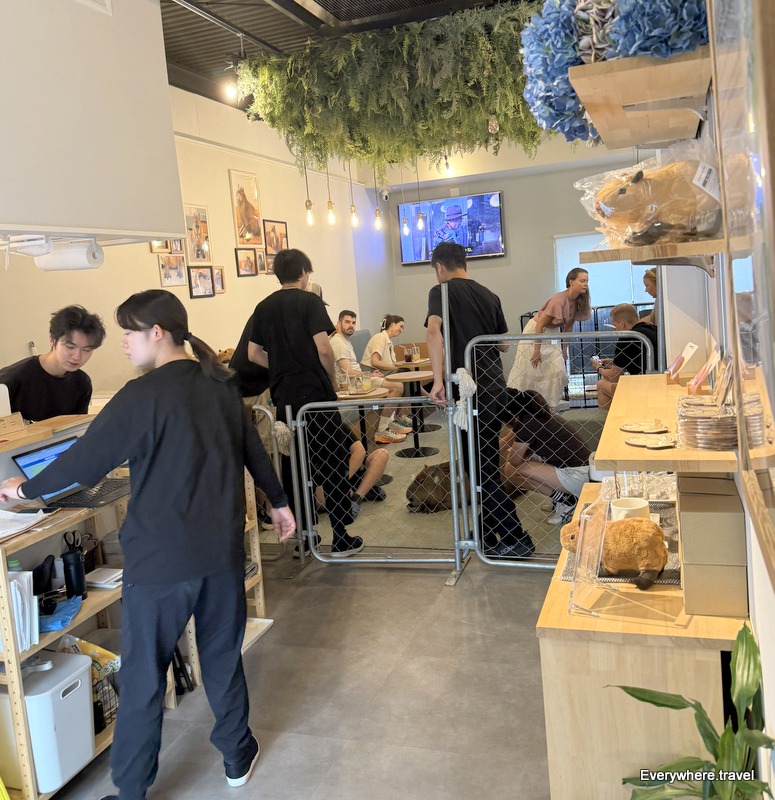
This is the original Cafe Capyba and the one we visited.
It’s home to Kohaku and Pisuke, who roam freely around the cafe while visitors sit with them, pet them and feed them treats.
We loved it.
The cafe itself is at street level, while upstairs there’s a separate waiting area with lockers where you can leave your belongings before going in. I really appreciated this setup because it meant bags and coats weren’t cluttering the relatively small area where everyone was interacting with the capybaras and it just felt more relaxed when we weren’t squeezed into a tiny space.
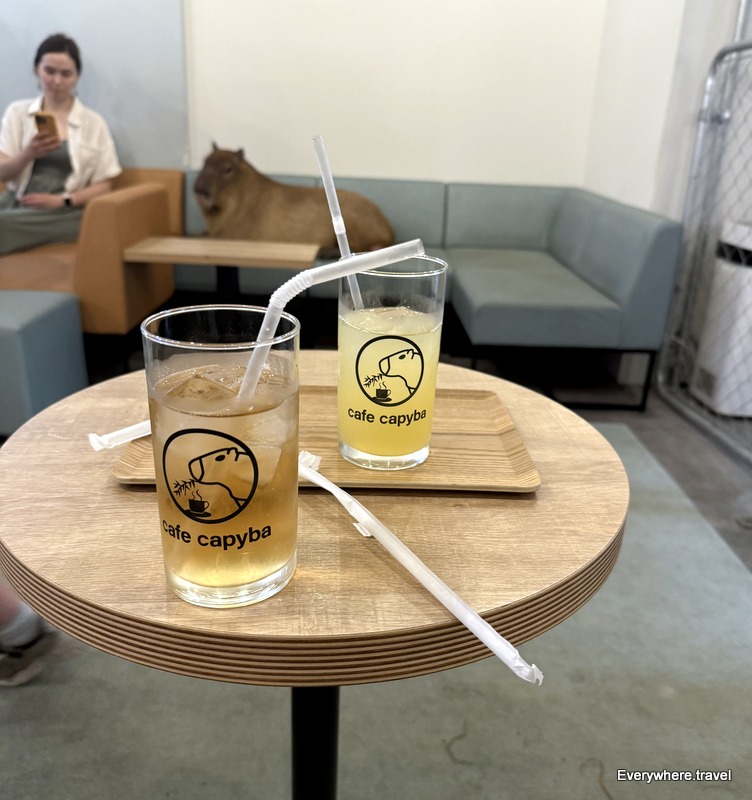
The standard visit is 30 minutes and currently costs ¥2,300 per person, including one drink which is a choice of various coffees, tea or apple juice. Capybara vegetables cost another ¥330.
You can potentially extend your visit in 10-minute increments for ¥440, although extensions depend on availability on the day. I wouldn’t count on being able to stay longer when planning your visit. This cafe is super popular.
Guests must be at least six years old, and children under 12 need to be accompanied by a guardian.
Cafe Capyba is reservation-only, with bookings opening two weeks ahead at midnight Tokyo time. This is one I would book as soon as your date becomes available because it’s extremely popular.
To get a reservation for this cafe, I had to set my alarm for 1am (midnight Tokyo time) two weeks before to book the tickets. They sold out within minutes!
For me, the combination of two capybaras, a straightforward interaction-focused experience and a relatively low price makes Hikifune very hard to beat.
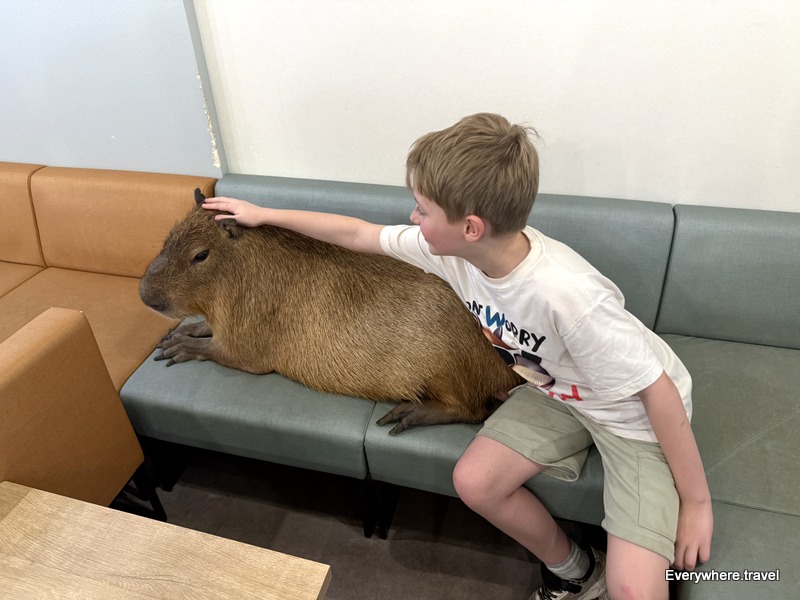
Cafe Capyba Asakusa
The newer Asakusa branch follows essentially the same concept but is much more convenient if you’re already sightseeing around Asakusa.
Its resident capybaras are Mugi and Pecan.
The pricing is currently the same as Hikifune: ¥2,300 for the first 30 minutes including a drink, with vegetables for the capybaras costing ¥330 and possible 10-minute extensions costing ¥440.
The same minimum age of six applies, and reservations can be made up to two weeks ahead.
I haven’t personally visited this branch, so I can’t tell you that the experience is identical to Hikifune. However, if you’re trying to fit a capybara cafe around a Tokyo itinerary, its location is a big advantage. It’s close enough to combine easily with a day exploring Asakusa and Senso-ji.
If location didn’t matter, I’d currently choose Hikifune because that’s the Cafe Capyba experience I know and loved. If you’re already visiting Asakusa, the newer branch could be far more convenient.
Note that both the Capyba Cafes are closed on Wednesdays and Thursdays.
Click here for more details or to book a Capyba Cafe.
Capyneko Cafe – Kichijoji and Harajuku
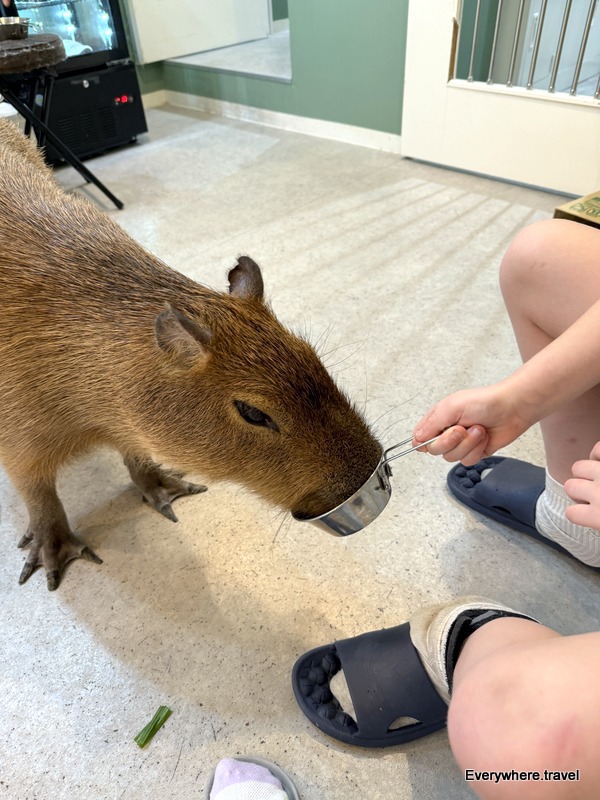
Capyneko is quite a different proposition because this isn’t just a capybara cafe.
It’s a capybara and cat cafe.
That makes it an obvious choice if you love both animals, and there’s a nice additional element to the concept: part of the cafe’s proceeds supports cat rescue activities.
There are currently two locations, the original in Kichijoji and a newer branch on Takeshita Street in Harajuku.
Capyneko Cafe Kichijoji
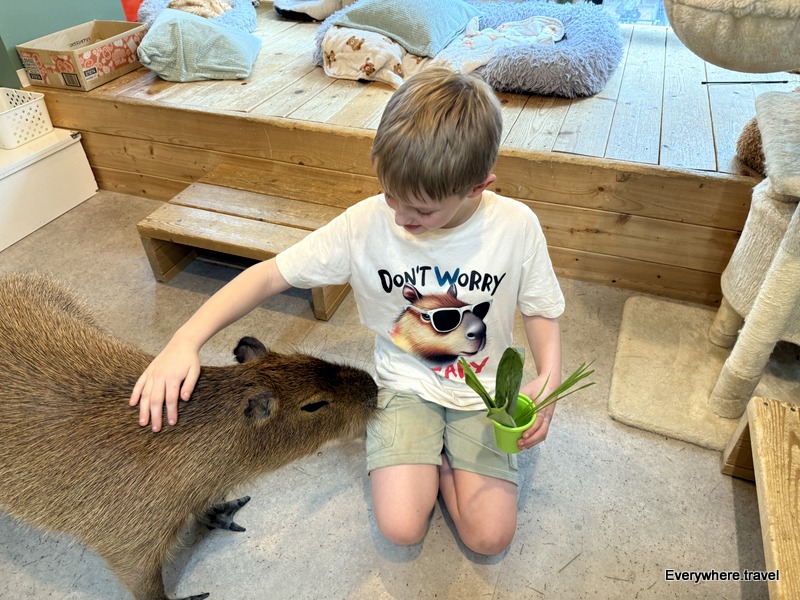
We visited the Kichijoji cafe, which has one capybara living alongside the cats.
Sessions last 40 minutes and currently cost ¥2,800. Special capybara treats cost ¥550 each. They also gave us something to feed the capybara for free. A drink is also included which we could select from a fridge.
I enjoyed the experience, but it felt much more squished than Cafe Capyba.
You take a small elevator upstairs to the cafe and arrive in a tiny lobby area where everyone is checked in. There really isn’t anywhere comfortable to hang around, so don’t arrive early thinking you’ll wait inside.
There’s also only a small area to store your belongings. I’d avoid bringing large bags if you can.
Once you’re inside, however, you have both the capybara and cats to interact with. This gives the experience more variety than Cafe Capyba, particularly if not everyone in your group is quite as capybara obsessed as my son.
I still prefer Cafe Capyba for the actual capybara experience. Having two capybaras rather than one makes a difference, and I preferred the physical setup.
But if the idea of spending 40 minutes surrounded by both a capybara and cats sounds like heaven, Capyneko could easily be your winner. I found the staff friendlier here.
There is also no minimum age limit here. Kids under 1 are free.
Reservations are recommended. Walk-ins can be accepted when there’s space, but I wouldn’t rely on that when planning a Tokyo vacation.
Capyneko Cafe Harajuku
Capyneko’s second Tokyo location is on Takeshita Street in Harajuku.
The concept is the same – 2 capybaras plus cats – and sessions are also 40 minutes. However, it costs considerably more at ¥3,850 per person compared with ¥2,800 in Kichijoji. Treats are ¥550.
That extra cost is largely something I’d weigh against convenience.
Harajuku is on the sightseeing itinerary of most first-time Tokyo visitors, whereas Kichijoji is farther from the main central sightseeing areas. If you’re already spending a day around Harajuku, Shibuya and Omotesando, paying more may be worth it to avoid traveling across the city specifically for a capybara cafe.
Plus, you do get to see two capybaras at this cafe.
If you’re choosing purely on price, Kichijoji wins.
Click here to book either Capyneko Cafe.
CAPPINESS – Shinjuku and Oshiage
CAPPINESS offers one of the more structured capybara cafe experiences in Tokyo.
Rather than simply paying for entry and then buying extras, the ¥4,000 ticket includes a 40-minute session with capybara feeding, self-service drinks, an educational component, a souvenir and a group photo.
There are two locations: Shinjuku and Oshiage.
Both are reservation-only and bookings open 30 days ahead, which is useful if you’re organizing a Tokyo itinerary well in advance.
The minimum age is five, with children aged 5–12 required to visit with a guardian.
CAPPINESS Shinjuku
The Shinjuku cafe is the more centrally convenient of the two for many Tokyo itineraries and has a cute, cozy style.
There are three capybaras, giving it an immediate advantage over cafes where all the visitors are sharing their attention with a single capybara.
At ¥4,000, it’s substantially more expensive than Cafe Capyba, but it’s not an apples-to-apples comparison. You get 40 rather than 30 minutes, and feeding, drinks, the photo and souvenir are already included.
CAPPINESS Oshiage
The Oshiage location follows the same basic format: three capybaras, a 40-minute session and a ¥4,000 ticket with feeding and the other inclusions.
Its biggest advantage is location.
Oshiage is the home of Tokyo Skytree, and Asakusa is nearby, so it’s easy to combine this cafe with sightseeing in northeastern Tokyo.
The cafe describes this branch as having a more modern, refined atmosphere than the cozier Shinjuku location.
Again, reservations open 30 days ahead and are required.
Between the two CAPPINESS branches, I would primarily choose according to which location works better with the rest of your Tokyo plans rather than traveling across the city for one over the other.
CapyVillage – Shibuya
CapyVillage is the option I’d choose if you want more than just capybaras.
Its star is Tonkatsu, the cafe’s single capybara, who has his own large bath. You can feed him, pet him and even give him a gentle massage.
But Tonkatsu isn’t alone.
CapyVillage is also home to hamsters, hedgehogs, lesser hedgehog tenrecs and prairie dogs, with the animals included depending on which session you choose.
This is where the pricing needs a little explanation because CapyVillage can initially look cheaper than it really is for a tourist who wants a guaranteed visit.
A 30-minute session costs just ¥1,800, but you choose either the capybara or hamsters. The 45-minute option is ¥2,500 and adds capybara, hamsters and hedgehogs.
The full 60-minute experience costs ¥3,200 and includes the capybara, hamsters, hedgehogs and prairie dogs.
One bottled drink is included. Capybara veggie sticks cost ¥500, while an ¥800 set provides treats for each of the animals. Children are given a lettuce leaf to feed the capybara for free.
The important catch is advance reservations.
If you want to lock CapyVillage into your Tokyo itinerary ahead of time, book the one-hour experience. Shorter sessions may become available on the day, but same-day slots aren’t guaranteed and can be extremely limited during busy periods.
So I wouldn’t compare CapyVillage’s ¥1,800 headline price directly with Cafe Capyba’s ¥2,300 ticket and conclude CapyVillage is cheaper.
For a tourist who doesn’t want to risk turning up and missing out, the more realistic comparison is ¥3,200 for the advance-bookable one-hour experience.
Children aged three and over can participate, with elementary-school-aged children and younger needing an adult guardian. This makes CapyVillage one of the better choices in this list for families with younger children.
It’s located in Sendagaya in Shibuya City rather than in the middle of the Shibuya Crossing area.
Click here to book CapyVillage.
Capybara Cafe Moffu Harajuku
Moffu is one of the most intriguing options if your priority is simply more capybaras.
Located right on Takeshita Street in Harajuku, it generally has three capybaras available, although the number visitors actually see can vary because the animals take breaks.
That’s considerably more than the single capybara at Capyneko or CapyVillage.
A 30-minute advance ticket currently costs ¥4,000 and includes all-you-can-drink beverages. If you want longer, you need to make consecutive reservations rather than simply deciding to extend once you’re inside.
Advance reservations open 30 days ahead.
There’s no waiting area, and guests are asked not to arrive more than five minutes before their session. That’s worth knowing on Takeshita Street, which can be absolutely packed.
Guests aged 14 and under need to be accompanied by a parent or guardian.
Moffu also shares a building with a Samoyed cafe, so serious animal lovers could potentially turn this into a very fluffy afternoon.
The downside is price.
At ¥4,000 for 30 minutes, it’s considerably more expensive than Cafe Capyba, despite the shorter session. You’re really paying for the Harajuku location and the chance to interact with a larger group of capybaras.
For someone whose number-one goal is to see as many capybaras as possible, that may be completely worth it.
Click here to book this capybara cafe.
Final Words
So which is the best capybara cafe in Tokyo?
My current winner is Cafe Capyba Hikifune.
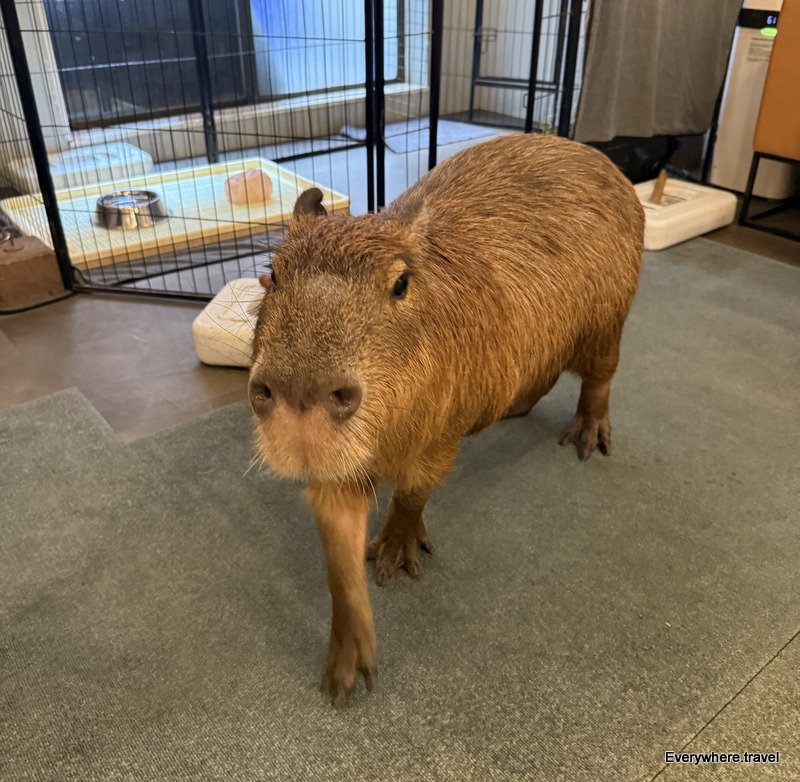
We had a fantastic experience there, there are two capybaras to interact with, the setup works well and ¥2,300 including a drink is very reasonable compared with several of the alternatives.
But there’s no single cafe that’s best for absolutely everyone.
I’d choose Capyneko if you want cats as part of the experience, CAPPINESS if you want a longer, more structured package with feeding included, CapyVillage if you want to meet several different types of animals, and Moffu if having more capybaras or being right in Harajuku matters most.
But really, they all allow you to interact with capybaras, so I would take location into account most of all.
Tokyo is enormous, and I wouldn’t spend an extra hour crossing the city merely to save a few hundred yen. Cafe Capyba Asakusa and CAPPINESS Oshiage fit nicely with Asakusa and Tokyo Skytree sightseeing, while Capyneko and Moffu have branches in Harajuku.
Whichever one you choose, book ahead.
These are small cafes with limited sessions, and the best-known ones can fill up. If spending time with a capybara is high on your Tokyo wish list, this isn’t something I’d leave until you arrive.
And if you’re wondering whether a capybara cafe is actually worth adding to a Tokyo itinerary, my answer is an easy yes.
My son absolutely loves capybaras, so I expected him to enjoy it. What surprised me was how much I loved it too. Sitting on the floor beside these giant, ridiculously chilled animals was one of those wonderfully strange Tokyo experiences that we’ll remember long after we’ve forgotten another temple or shopping street.
We’re already going back for more.
Learn more about the fabulous things to do in Tokyo with our full guide here. You can also find all our guides to awesome experiences in Asia here.
